• A Gift from My Mother

    A Gift from My Mother

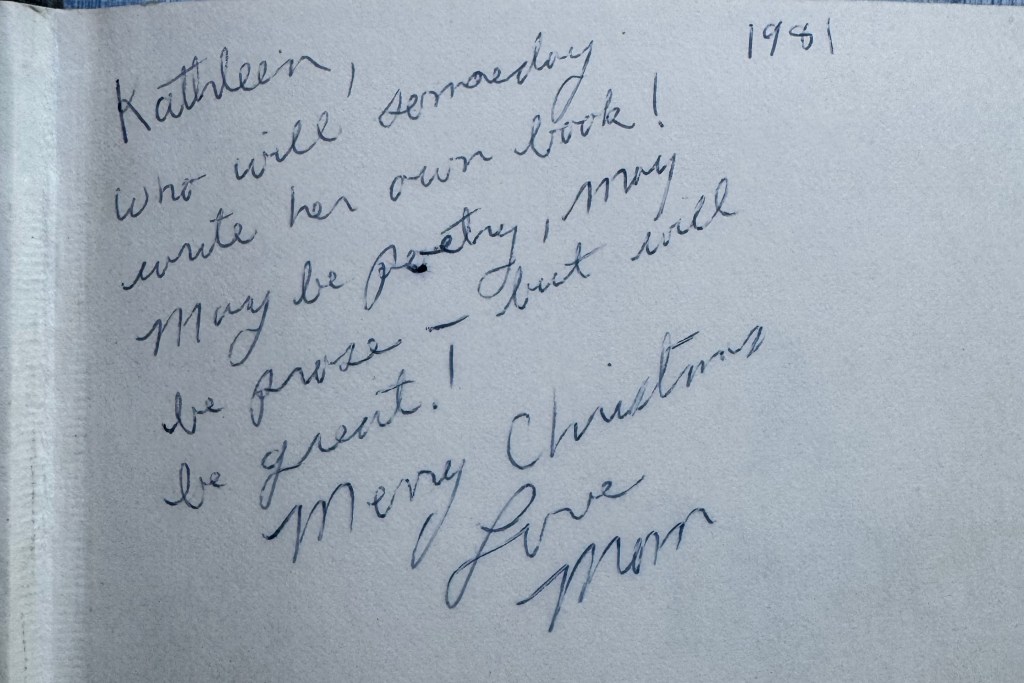
    The other day I was browsing through my bookshelves for suitable vacation reads when I came across my childhood copy of Shel Silverstein’s A Light in the Attic. I flipped it open and there, on the flyleaf, was my mom’s familiar handwriting:

    For Kathleen, who will someday write her own book!  May be poetry, may be prose —but will be great! Merry Christmas Love, Mom

    It was dated 1981. I had won some sort of writing competition at Somerset Junior High earlier that year.* There was an evening ceremony where I was presented with a Webster’s dictionary for my efforts, along with an appropriately fancy certificate. Both are long gone now. But, boy, was my mom excited.

    In truth, she was far more excited than I was.  I was so fucking awkward in seventh grade that the last thing I wanted to do was walk across the gymnasium and shake hands with my creative writing teacher and the principal. I was convinced this was yet another nail in my popularity coffin. But mom beamed proudly through the awards ceremony and even dragged my dad along.

    At Christmas the book of poetry was wrapped and waiting under our tree. I was a huge Shel Silverstein fan after three consecutive years of Mr. O’Grady’s language arts classes in elementary school. Mr. O’Grady read all sorts of novels to us, but he read from Silverstein’s Where the Sidewalk Ends like it was scripture. Regularly, reverently. I promise you, every single kid who had Mr. O’Grady at Standiford School knows who Sarah Cynthia Sylvia Stout is. My own copy of the newly published Light in the Attic was way cooler than winning the award. And, yeah, I still have the book.

    Fast forward thirty-five years. My mom is in the local emergency room, her third or fourth visit in a two-month span. She has congestive heart failure, and this isn’t going to end well for her and we all know it. These regular trips to the ER were stressful and frightening for all of us, but especially my mom. She was in a showdown with her own mortality. I remember following her into the house after one of these ER stays. She was moving slowly, gingerly, and suddenly she stopped altogether. “This is harder than I thought it would be” is all she said. She didn’t elaborate.  She didn’t even turn around to look at me. She didn’t have to.

    Anyway, I remember this ER visit specifically, because we were in a room by ourselves, my mom hooked up to a line of medical equipment and me sitting on the bed next to her. We sat in silence for awhile, just listening to the rhythmic beeps and sighs of the machines. Suddenly she reached over, grabbed my arm, and whispered something urgently. I had to lean down close and ask her to repeat what she said.

    “I want you to write a book.”

    Nothing can prepare you for these moments in your life. If there had been a manual to read or a workshop to attend, I might have had the wherewithal to respond gently, affirmatively. Instead, I leapt away from the bed like it was on fire. “Oh no you fucking don’t!” Mom closed her eyes in response. “Hey,” I said, squeezing her shoulder, “HEY. You are not going to die right now with your last wish being for me to write a book! Do. Not. Do. That. To. Me.” Her eyes still closed, my mom managed to smile. Then a doctor appeared to work their magic and soon we were on our way home again. Her dying-not-dying wish forgotten by her, I’m sure. But not by me.

    I’m starting this blog because I don’t have a book in me, at least not yet. But I just might have a blog.

    This is for you, mom.

    *The story was called “Sundays.”  To the best of my memory, was a post-apocalyptic tale of a world where we had so badly screwed up the ozone layer – ozone was a big deal back then – that the sun’s radiation had become hostile and dangerous. There were only a few days a year – days carefully calculated by climate scientists – where what was left of the ozone layer would drift over where you lived and everyone could go outside for a spell. Even then you needed special glasses and clothing, or the sunlight could kill you. There was some weird ritual involved in sun days, and parents would try to be festive but they were totally faking it because they remembered the days when you could just, like, play in the sunshine every day. And the kids knew their parents were sad and so would themselves try to be festive, but deep down they were sad, too, because they never could just play in the sunshine. So, remember this happy tale the next time you read an article about kids today having a bleak view of the future.

    Leave a comment

  • Feral Thrifting

    I’m spending the summer in Paris, my third such summer in the last 6 years. It’s a long, strange trip that shaped me into a regular visitor to the City of Light, and some day I’ll likely share the details of that journey. However it happened, here I am, curled up on a couch in a pleasantly dilapidated apartment building in the 8th arrondissement.

    My daughter Molly will be arriving for a visit next week, and we have big thrifting plans. While other mother-daughter duos make their Parisian pilgrimages to Galeries Lafayette, the Bon Marché, and Hermès, we will be scouring the city for second-hand treasures. I’ve made a checklist of 44 thrift stores in the greater metropolitan area. And to be clear, there are no designer thrift stores on this list. Molly and I are feral thrifters.

    Curation plays no role in feral thrifting. The kind of thrifting we like doesn’t happen in upscale consignment shops, vintage stores, or resale boutiques. There is nothing wrong with this sort of second-hand shopping, of course, and for many it’s the only acceptable option. It’s just not feral.

    Feral thrifting takes place in feral stores. The kinds of places where people pull up in back alleys, open their trunks, and start piling boxes and bags of unwanted goods onto a loading dock. Maybe their closets grew too full, their bodies too large, or the latest issue of Vogue said their hemlines were too outdated. Perhaps they painted their living room a different color or bought a new sectional and none of this stuff matched anymore. Maybe their mother died and after a year of enshrining her belongings in the garage they awoke one morning to find the grief had shifted just enough for them to move on. Marie Kondo, I’m certain, has inspired and will continue to inspire legions of folks to haul trunks full of joyless goods down to their local charity’s retail arm.

    Whatever the motivation, people are booting all sorts of perfect, imperfect, immaculate, soiled, whole and broken objects out of their lives and onto that loading dock, raw and uncut, history clinging to every item like a scent. Within days – possibly even hours — it will be on the shelves and ready for us.  

    We are feral, too. We like the way history smells: smoky, musky, slightly sweet. Google “thrift store smell reddit” and you will find hundreds of people sharing their distaste for the scent of thrift stores and trying to get to the bottom of why all thrift stores smell the same. I’m always surprised at how many people think this smell comes from a detergent or disinfectant. Wishful thinking maybe.

    Like Soylent Green, the ubiquitous scent in your local Goodwill is PEOPLE, people. I understand why the general populace finds it repellant, the stink of humanity is not typically listed as a selling point. But, for me, walking into the familiar smell of my local Salvation Army is as evocative as walking into my grandmother’s kitchen 50 years ago. Comforting and full of promise.
    Many of my friends tell me they “don’t have the patience” for thrift store shopping. Or that they “never find anything.” Yes, patience is required. The patience of a hunter. And if you’re not finding anything it’s because you’re not looking at absolutely everything. Yes, you really may need to paw through that entire bin of frayed scarves for the single silken reward; to shuffle through long racks of coats like a blackjack dealer – quick and thorough – to find your cashmere or camelhair prize. Thrifting is Easter egg hunting for grown-ups. A variable reward extravaganza, your brain flooding with sweet dopamine when you unearth those soft leather boots from the box of worn footwear.

    Garage sales were my gateway into thrifting. I started my love affair with garage sales at a very young age, back when we rode bicycles around the neighborhood all summer long and had pockets full of allowance money to spend. I could ride to Quik Stop and buy a Big Hunk for a quarter in 1979, or I could stop by the garage sale down the street and come home with an electric card shuffler, a rabbit foot keychain, or a slightly-used Yo-Yo that lit up as it spun. As young as age 10 I fully recognized and appreciated these amazing bargains.

    A voyeur by nature, garage sales were also an efficient way to investigate the lives of our neighbors. To see what books they read, what clothes they wore, what toys they had outgrown and tools they had replaced. I could live out my considerable Harriet the Spy ambitions and own a light-up Yo-Yo for the cost of a candy bar? Seriously, what’s not to love about that?

    When I was in junior college I spent a semester abroad, knocking off some general education units at the American Institute for Foreign Study in London. To stave off my considerable homesickness I would often roam the massive Portobello Road market after school. On Saturdays the antique vendors were out in full force, but on weekdays you’d get the normal folks selling a hodgepodge of clothing, jewelry, housewares, and books. Portobello Road on Tuesdays was a garage sale on steroids.

    I had emptier pockets as a college student, and the markets were less about buying and more about discovering. I was an archaeologist with an endless appetite for digging down into clothing racks, jewelry trays, and damp boxes full of jumbled bric-a-brac. I didn’t want to possess these things as much as I wanted to inventory them. 

    My school provided students with an array of low-cost travel opportunities, from day trips to Oxford to a homestay system allowing us to spend weekends with families all over England. I took advantage of these extracurricular options and then branched out to taking occasional weekend trips on my own or with a friend. Most of the towns in England have multiple charity shops on their high streets, and with the Portobello Road serving as my gateway drug, I started visiting them. Oxfam, British Heart Foundation, Cancer Research UK, Barnardos. By the time I returned home to California I was hooked.

    Leave a comment